
CASE STUDY
Stihl Australia

Highlights
-
Repositioned STIHL from a contractor-only perception to a clearly understood retail destination
-
Unified external signage, internal shop signage, and décor into a single retail experience
-
Established a consistent, family-of-stores system across a national network
-
Enabled scalable growth from ~250 to 500+ stores with controlled rollout

Role Summary
-
Signage strategy development
-
Messaging hierarchy and retail repositioning
-
Signage guidelines and standards
-
Ongoing rollout advisory and design evolution
Key Outcomes
-
Repositioned STIHL from a contractor-only brand to a clearly understood retail destination
-
Established a consistent, family-of-stores signage system across a national network
-
Regained control over signage standards, reducing variations, exceptions, and cost leakage
-
Enabled scalable growth, supporting expansion from ~250 to 500+ stores with faster rollout


Overview
When Mark Retail commenced work with STIHL Australia, the brand was exceptionally strong with contractors and government clients but significantly underperforming with retail consumers. Stores were widely perceived as trade-only destinations, and many retail customers were unsure whether STIHL shops sold to the public at all.
Both the external signage and the internal shop environment reinforced this perception. Messaging referenced “Outdoor Power Equipment” — a category unfamiliar to most retail customers — while internal signage and décor lacked the clarity, structure, and familiarity expected in a contemporary retail setting. As a result, stores were unintentionally discouraging retail foot traffic.
Strategic Approach
The strategy addressed the entire customer journey, from first sight of the building through to the in-store experience.
Externally, Mark Retail redefined the retail messaging hierarchy, shifting from trade-focused language to customer-understood terminology such as “Garden Power Tool Specialists”. Signage was restructured to educate customers at a glance, supported by clear product categories and qualifying statements that explained what the store offered and who it served.
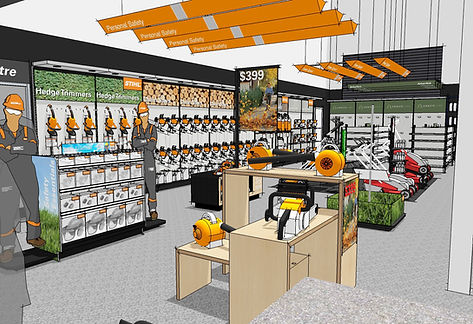
Internally, the shop signage and décor were comprehensively redesigned to reinforce this message. Internal wayfinding, category signage, product communication, finishes, and colour palettes were aligned with the external strategy to create a retail environment that felt familiar, legible, and comfortable for everyday consumers.
Changes to building colour and contrast further strengthened presence in the retail streetscape, ensuring the store felt contemporary, confident, and clearly part of a recognisable retail family.
System, Control, and Rollout
Beyond strategy and design, Mark Retail developed comprehensive external and internal signage guidelines to ensure consistency across the national dealer network. This replaced a previously uncontrolled approach where individual dealers applied signage, supplier logos, and in-store graphics independently.
The new system introduced clear rules, tighter controls, and structured schedules governing both external signage and internal shop presentation. This enabled accurate scoping, reduced variations, and improved cost control, while making signage easier to quote, manufacture, approve, and install.
Mark Retail worked directly with STIHL head office, marketing, and network development teams through regular design meetings and live, on-screen 3D working sessions. These sessions allowed stakeholders to review both exterior and interior environments together, ensuring decisions were coordinated and defensible.
Outcome
Over a 15-year partnership spanning three iterations of the signage and store environment system, STIHL experienced substantial growth in retail recognition, foot traffic, and dealer recruitment. The network expanded from approximately 250 stores to more than 500 locations, supported by a retail system that could scale without losing clarity or control.
Today, STIHL stores present as a cohesive retail family — externally recognisable and internally consistent — with signage and décor that support customer understanding, confidence, and ease of navigation. The project demonstrates how a coordinated external and internal signage strategy can materially influence brand perception, retail performance, and long-term network growth.
CASE STUDY
Goodyear Autocare

Highlights
-
Optimised global signage standards to suit Australian conditions and budgets
-
Unified external signage and internal reception design into a single experience
-
Reduced over-specification, lowering manufacturing and installation costs
-
Enabled faster, more consistent rollout across a diverse dealer network

Role Summary
-
Signage strategy optimisation
-
External building signage design and guidelines
-
Internal reception design strategy
-
Site audits and surveys
-
3D concept development (external + internal)
-
Technical documentation and tender support

Key Outcomes
-
Unified the external and internal customer experience under a single strategy
-
Reduced costs by eliminating over-specification and unnecessary signage
-
Improved clarity and consistency across a diverse national dealer network
-
Streamlined approvals and rollout through live 3D review and alignment


Overview
Goodyear Australia was implementing a new signage scheme developed by an international branding advisory firm as part of a global brand programme. While the global retail playbook was comprehensive and highly detailed, it proved costly to implement and difficult to apply consistently across the Australian dealer network.
Signage solutions were heavily over-specified, with premium manufacturing techniques and excessive sign quantities applied uniformly to both new and existing sites. At the same time, the customer experience often lacked continuity between the exterior of the building and the internal reception environment.
Mark Retail was engaged to reinterpret and optimise the global standards—retaining brand intent while adapting the strategy for practical, cost-effective delivery across real-world sites.
Strategic Approach
Rather than redesigning the brand, Mark Retail focused on refining how it was expressed physically. This included both external building signage and internal reception environments, allowing the customer experience to be managed holistically from first approach through to point of engagement.
Externally, the signage strategy was simplified to reduce visual clutter, improve message hierarchy, and ensure each sign served a clear purpose. Internally, reception layouts, finishes, and signage elements were aligned with the external strategy to create a consistent, legible transition from outside to inside.
The emphasis throughout was clarity over quantity—ensuring customers immediately understood where they were, what services were offered, and how to navigate the space.
Outcome
The optimised approach delivered measurable improvements across the network. Manufacturing and installation costs were reduced through simplified fabrication and controlled scope. Readability and customer understanding improved through clearer hierarchy and better integration between exterior and interior environments.
Approvals and rollout became faster and more consistent, with fewer exceptions and variations. By controlling the customer experience from outside the building through to reception, Goodyear achieved a signage and interior system that was practical, scalable, and aligned to both brand standards and operational realities.
CASE STUDY
Dunlop Super Dealers


Highlights
-
Reinforced Dunlop’s established brand authority without diluting recognition
-
Clarified brand and service hierarchy across exterior and interior environments
-
Simplified signage systems while maintaining a robust, performance-led aesthetic
-
Enabled consistent national rollout across diverse Dunlop Super Dealer sites

Role Summary
-
Signage strategy optimisation
-
External building signage design and guidelines
-
Site audits and surveys
-
3D concept development (external + internal)
-
Technical documentation and tender support

Key Outcomes
-
Strengthened Dunlop brand presence across all customer touchpoints
-
Improved navigation and service clarity without over-signage
-
Reduced manufacturing and installation costs through controlled specification
-
Greater consistency across a diverse national Super Dealer network
-
Faster approvals and rollout through clear, practical documentation
Overview
Dunlop Australia undertook a national refresh of its Dunlop Super Dealer network. As a globally established performance brand, the objective was to strengthen physical brand expression without diluting recognition—delivering clearer, more consistent signage aligned to Dunlop’s specialist motorsport and adventure-focused positioning.
Strategic Approach
Rather than redesigning the brand, the strategy refined how it was expressed on site. Signage systems were simplified and prioritised to reinforce Dunlop’s hard-core, no-nonsense character, improving legibility and customer flow while remaining practical to implement across new, refurbished, and legacy locations.
Outcome
The optimised approach strengthened brand presence through clarity rather than quantity. Signage became easier to understand, faster to approve, and more cost-effective to roll out, delivering a consistent national customer experience that reinforced Dunlop’s performance-led identity across the Super Dealer network.


CASE STUDY
Think Water

Highlights
-
Translated a new brand identity into a cohesive external and internal signage system
-
Shifted perception from contractor-only to a retail-accessible destination
-
Balanced national consistency with local flexibility across independently owned stores
-
Strengthened brand presence across a growing network of 40+ locations

Role Summary
-
Signage strategy development
-
External building signage design
-
Internal showroom signage and branding
-
Flexible signage guidelines for dealer networks
-
Rollout support across multiple locations

Key Outcomes
-
Established a clear, recognisable national brand presence
-
Improved retail customer accessibility and understanding
-
Balanced standardisation with flexibility for independent operators
-
Strengthened consistency across a growing national network


Overview
Think Water had recently developed a new logo, tagline, and colour specification, but lacked a practical signage system to apply the brand consistently across its retail network. While the brand identity existed on paper, there were no signage guidelines or physical standards to guide how it should appear on buildings or within stores.
At the same time, Think Water was expanding its national footprint and seeking to broaden its customer base beyond contractors to attract more retail trade. Without a clear signage and in-store communication strategy, stores continued to present as independent operators rather than part of a cohesive national brand.
Mark Retail was engaged to develop both external signage design and a complete internal showroom rebrand, ensuring the brand could be experienced consistently from first approach through to the in-store environment.
Strategic Approach
The strategy focused on translating Think Water’s brand identity into a clear, legible physical system that would work across a diverse dealer network.
Externally, signage was designed to be largely standardised, creating a strong, recognisable presence and reinforcing the sense of a national brand. Clear message hierarchy and simplified communication ensured customers could quickly understand what Think Water offered and who it served.
Internally, the approach was deliberately more flexible. Given the wide variation in product ranges between stores, internal signage and showroom branding were designed as adaptable components rather than rigid templates. This allowed each dealer to present their specific product mix clearly while still operating within a consistent brand framework.
The guiding principle throughout was clarity and simplicity — ensuring signage supported customer understanding without overwhelming either the space or the operator.
System, Control, and Rollout
Mark Retail developed signage and showroom branding guidelines that provided clear direction while allowing for controlled variation where required. This enabled independent store owners to adopt the brand confidently, without feeling constrained by a one-size-fits-all solution.
By establishing clear rules for external presentation and flexible tools for internal application, the system supported consistent rollout across the network while respecting the operational realities of independent businesses.
Outcome
The new signage and showroom system helped reposition Think Water stores from contractor-focused outlets to approachable retail destinations, while maintaining credibility with professional customers.
Store operators reported greater clarity in brand positioning and benefited from a stronger national presence, helping their businesses feel part of a larger, established network rather than isolated independents.
For customers, the result was clearer messaging, improved navigation, and a more consistent experience across locations.
The project demonstrates how a well-structured signage strategy can support growth, improve perception, and unify a network without sacrificing local relevance.